
GST return filing in Singapore requires GST-registered businesses to submit Form F5 via IRAS myTax Portal, declare output and input tax accurately, and make payment within one month after each accounting period.
Filing Goods and Services Tax (GST) returns is one of the most important statutory responsibilities for GST-registered businesses in Singapore. While the process appears straightforward on the surface, errors in GST return filing can expose companies to penalties, audits, and long-term compliance risks. Understanding how to file GST return in Singapore correctly is therefore not merely an administrative task, but a critical aspect of financial governance and tax risk management.
This guide explains the GST return filing process in Singapore from a professional advisory perspective, covering compliance obligations, timelines, common pitfalls, and best practices adopted by well-managed organisations.
Understanding GST Return Filing in Singapore
A GST return in Singapore is a formal declaration submitted to the Inland Revenue Authority of Singapore (IRAS) summarising a company’s taxable supplies, purchases, output tax collected, and input tax claimed for a specific accounting period.
Every GST-registered entity, regardless of whether it has made sales during the period, is required to submit a GST return. This includes periods where the business records zero taxable supplies, often referred to as “nil returns.”
The regulatory intent behind GST return submission is straightforward: to ensure transparency, traceability, and accountability in the indirect tax system. However, the execution demands discipline, accurate record-keeping, and a clear understanding of GST rules.
What Is GST Return Singapore?
A GST return Singapore, officially known as Form F5, is a quarterly or monthly declaration that reports:
- Output tax charged on taxable supplies.
- Input tax incurred on business purchases.
- Net GST payable to, or refundable from, IRAS.
The return also captures the total value of standard-rated, zero-rated, exempt, and out-of-scope supplies. These figures must reconcile with the company’s accounting records, invoices, and supporting documentation.
From a compliance standpoint, IRAS expects GST returns to be accurate, complete, and supported by proper records for at least five years.
GST Return Filing in Singapore: Who Needs to File?
Any business that is:
- Compulsorily registered for GST (annual taxable turnover exceeding S$1 million).
- Voluntarily registered for GST.
Must file GST returns for every prescribed accounting period.
It is important to note that voluntary registration comes with stricter compliance expectations, including a minimum registration period and potential penalties for non-compliance.
How to File GST Return in Singapore
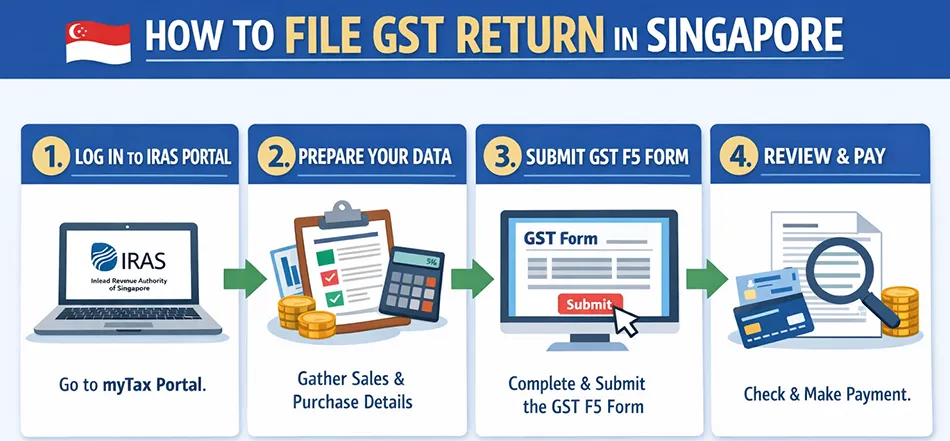
The Singapore GST return submission process is conducted entirely online through the IRAS myTax Portal. While the system is user-friendly, filing accuracy depends heavily on preparation before logging in.
Step 1: Prepare Your GST Records
Before submitting a GST return, businesses should ensure that all relevant transactions for the accounting period have been properly recorded. This includes sales invoices, purchase invoices, credit notes, and import/export documentation.
A common compliance failure arises when GST is filed directly from bank statements or incomplete records rather than from reconciled accounting data.
Step 2: Log in to IRAS myTax Portal
Authorised users can access the GST filing section using Singpass or Corppass. Only individuals granted the appropriate tax role are permitted to submit returns on behalf of the company.
Step 3: Complete Form F5
Form F5 requires the declarant to input values for:
- Total value of standard-rated supplies.
- Output tax due.
- Total value of taxable purchases.
- Input tax claimed.
Although the form itself is structured, professional judgement is often required when classifying complex transactions, such as mixed supplies, reverse-charge services, or partially exempt activities.
Step 4: Submit and Make Payment
Once the GST return is submitted, payment must be made within the stipulated deadline. Late payment attracts penalties and interest, even if the return itself was filed on time.
GST Return Submission Deadlines in Singapore
GST returns must be filed within one month after the end of each accounting period. For example, if a GST quarter ends on 31 March, the return and payment must be completed by 30 April.
From an advisory standpoint, businesses should treat GST deadlines as non-negotiable. IRAS adopts a strict enforcement approach, particularly for repeat defaulters.

Common Mistakes in GST Tax Return Singapore
Despite clear guidelines, GST errors remain one of the most frequent triggers for IRAS audits. Some recurring issues include misclassification of supplies, over-claiming input tax, and failure to report reverse-charge transactions.
Another common risk arises from manual data entry without reconciliation. Even minor discrepancies can raise red flags when IRAS cross-checks GST data against income tax filings and third-party information.
Well-managed businesses mitigate these risks by implementing internal GST review processes or engaging professional GST advisory services.
Penalties for Incorrect or Late GST Return Filing
IRAS imposes penalties for both late filing and incorrect declarations. These may include:
- Late submission penalties.
- Late payment penalties.
- Additional tax assessments.
- Surcharges for negligence or wilful errors.
In more serious cases, IRAS may impose composition fines or initiate audits. From a governance perspective, GST compliance should be treated as part of the company’s overall risk management framework.
Best Practices for GST Return Filing in Singapore
Experienced businesses approach GST filing as an ongoing process rather than a quarterly task. Regular reconciliation, proper invoice management, and periodic GST health checks help reduce compliance risks.
Engaging professional support becomes particularly valuable when dealing with complex transactions, business expansion, or changes in GST regulations. A proactive approach often prevents costly corrections later.
When Should Businesses Seek Professional GST Support?
While small businesses with straightforward transactions may manage GST filings internally, professional support is advisable when:
- The business engages in cross-border transactions.
- Reverse-charge or overseas vendor services are involved.
- Partial exemption rules apply.
- The company is undergoing restructuring or expansion.
In such scenarios, GST advisory support ensures that returns are filed correctly and defensibly.
Future-Proofing Your GST Compliance
GST regulations evolve over time, reflecting changes in international tax frameworks and domestic policy. Businesses that treat GST compliance as a static process often fall behind regulatory expectations.
A forward-looking approach includes regular training, system upgrades, and periodic compliance reviews. This ensures that GST return filing remains accurate, efficient, and audit-ready.
Conclusion
Understanding how to file GST return in Singapore is essential for maintaining regulatory compliance and financial credibility. While the technical process is standardised, the underlying accuracy depends on sound accounting practices, proper documentation, and informed judgement.
Businesses that adopt a disciplined, advisory-driven approach to GST return filing in Singapore not only reduce compliance risks but also strengthen their overall financial governance. In today’s regulatory environment, GST compliance is no longer just a tax function, it is a strategic responsibility.
Looking for professional GST return support? Contact SBC today for accurate, timely, and stress-free GST filing services.
Frequently Asked Questions
What is the GST return Singapore?
A GST return in Singapore is Form F5 submitted to IRAS, declaring output tax, input tax, and net GST payable or refundable for a specific period.
How often do I need to file GST returns?
Most businesses file GST returns quarterly, although monthly filing may apply in certain cases.
What happens if I file a GST return late?
Late filing results in penalties and may trigger closer scrutiny by IRAS, especially for repeat offences.
Can I submit a nil GST return?
Yes. Even if there are no taxable supplies, GST-registered businesses must submit nil returns.
Is GST return filing mandatory for voluntary registrants?
Yes. Voluntary GST registrants are subject to the same filing obligations as compulsory registrants.